
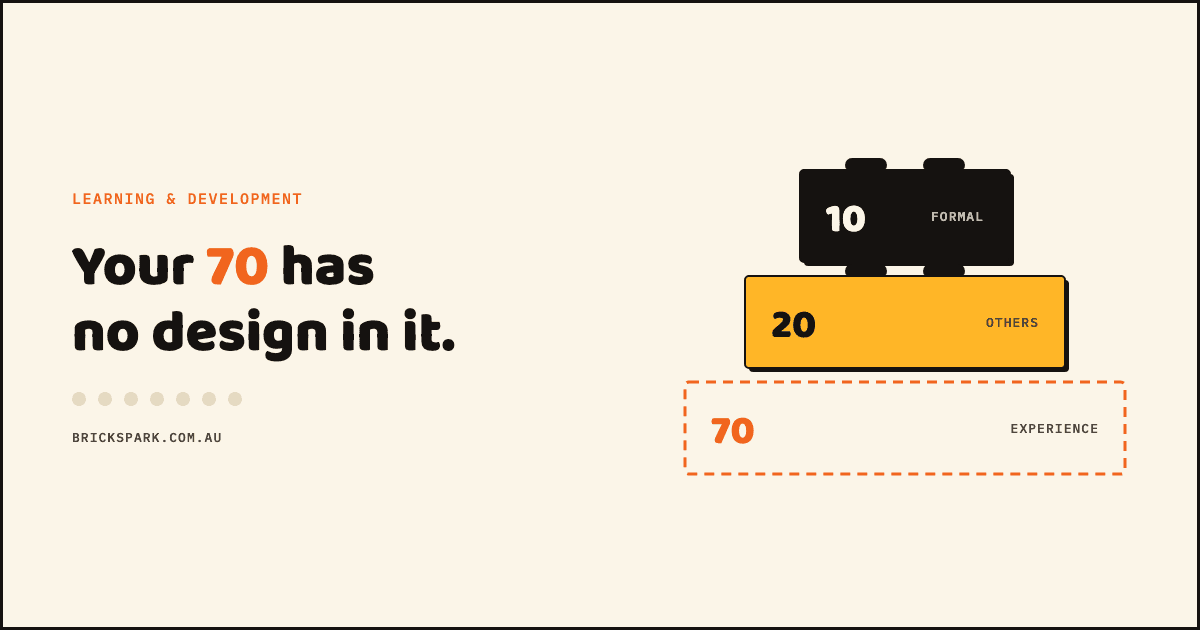
If you have built a capability plan in the last fifteen years, you have built one around 70:20:10. Seventy per cent of development from experience, twenty per cent from other people, ten per cent from formal training. It turns up in learning strategies, in framework diagrams, and in the slide that explains to an executive team why the training budget looks the way it does.
Before going further, it is worth being straight about where those numbers came from, because the story is not the one most people assume.
Where the numbers came from
The model traces back to The Lessons of Experience, published in 1988 by Morgan McCall, Michael Lombardo and Ann Morrison, drawing on a long-running study at the Center for Creative Leadership. Researchers interviewed 191 successful executives, asked them where they had learned the things that made them effective, and coded 616 key learning events into sixteen categories.
The phrase "70:20:10" does not appear in that book.
Robert Eichinger, who assembled the numbers alongside Lombardo, has since explained the rest openly. Sixteen categories were too unwieldy to teach, so they were recoded into five: challenging assignments, other people, coursework, adverse situations, and personal experience outside work. The last two accounted for a quarter of the lessons and could not be designed for, so they were set aside. What was left produced a split of 69:22:9, which was rounded to 70:20:10 because that is what people can actually remember. It reached print in a development planner in 1996, and from there it went everywhere.
So the ratio is a rounding of a subset of self-reported recollections, gathered from a small group of already-successful executives in large corporations, with no control group and no peer review. Morgan McCall, one of the original researchers, later described it as folklore. An Australian review by Kajewski and Madsen at DeakinPrime went looking for the empirical base and concluded there was not one. The Association for Talent Development has said on its own blog that the model is neither a scientific fact nor a recipe.
That is the concession, and it is better to make it yourself than to have someone in a budget meeting make it for you.
The shape is still right
None of that makes the model worthless. People do learn most of what they can actually do from doing real work, and from the people around them. That idea did not need a ratio to be true, and it survives the ratio being soft. Charles Jennings, who did more than anyone to popularise the model, has spent years saying the same thing: it is a reference model rather than a recipe, and arguing about whether the numbers are 70:20:10 or 52:27:21 misses what it was for.
The damage was never the idea. The damage was what got done with the number.
Once "formal training is only ten per cent" became a line anyone could quote, it became a reason to spend less on the ten. A 2021 paper in Public Money & Management traced exactly that pattern through UK policing, and the logic is hard to miss anywhere else: if the classroom only accounts for a tenth of development, why fund it? Organisations under cost pressure did not need much encouragement. Cutting the training budget when things get tight is one of the more expensive mistakes a business can make, and 70:20:10 handed people a respectable-sounding reason to do it.
There is a second problem, and it is the more interesting one.
What the Australian research found
In 2018, Samantha Johnson, Deborah Blackman and Fiona Buick published a study in Human Resource Development Quarterly looking at how 70:20:10 was actually working in the Australian public sector, where the APSC had been promoting it since 2011. They interviewed middle managers about their real experience of it.
The finding was that it was not delivering, even though the managers were aware of the framework and willing to take part. It was failing on four misconceptions in how it gets implemented, and the first one is the one worth sitting with:
an overconfident assumption that unstructured experiential learning will automatically result in capability development.
The others follow from it. Social learning was read far too narrowly, treated as a box marked "coaching and mentoring" rather than as what people absorb by watching how the managers around them behave. Formal training was expected to change behaviour on its own, with nothing to support it afterwards. And the three parts were never designed to work together. They sat in separate columns of a plan and were left to connect themselves.
The authors' conclusion is the line I keep coming back to. Social learning, they argue, is the glue that holds the formal and the experiential together. Take the glue out and you have three activities that do not add up to anything.
Nobody designs the 70
Read a few dozen capability plans and a pattern shows up.
The ten is designed to within an inch of its life. There are learning outcomes, a facilitator guide, a workbook, an evaluation form, and someone whose job it is to make all of that good. The twenty gets a mentoring program and a coaching panel. And the seventy, the biggest number and the one carrying most of the claimed weight, gets a line that says "stretch assignment."
Being thrown in the deep end is a story people tell fondly about their own careers, which is precisely the bias the original research was built on. Ask a successful executive how they learned and they will point at the hardest thing they survived. They will not mention the people who covered for them, the manager who reframed the problem in a corridor, or the eighteen months of ordinary work that made the stretch survivable. Experience gets the credit because experience is the part you remember.
What the Australian research says, and what anyone who has watched this closely already suspects, is that experience only produces capability when there is structure around it. Without that, people do not develop. They repeat what they already do, faster, and call it seniority.
The question to put to your own framework is what is designed inside your 70.
What designing it looks like
This is where I will declare an interest, because it is the work I do.
A facilitated session using the LEGO® Serious Play® method is not a training course, and I would not defend it as one. Nothing is being taught. There is no content to transmit, no learning outcome to assess, and the method's own literature is blunt that it is the wrong tool for building a specific skill. Which means, in 70:20:10 terms, it is barely the ten at all.
What it is, is structure applied to the seventy and the twenty.
The seventy, because the room works on a live problem the team already owns: the strategy that needs settling, the project about to start, the one that just finished badly, worked through a process that produces a decision and named next steps.
The twenty, because everyone builds before anyone talks, and every model gets shared. Contribution stops depending on confidence, seniority or how quickly someone can form a sentence under pressure. The social learning in most rooms is whatever the most senior person happens to model that day. This is the same social learning, deliberately spread across everyone in the room.
The part of your framework carrying the most weight is the part with the least design in it, and structured, facilitated work on a real problem is one of the few things that puts design there.
When it is the wrong answer
It is worth being equally clear about when it is not.
If the topic is simple, this is more process than the problem deserves. If there is one right answer, an analytical tool will find it faster and cheaper. If someone has already made the decision and wants the group to arrive at it, this is actively the wrong choice, because the method generates answers rather than delivering them. And if a team is in a bad way, a session like this opens people up, which needs to be part of a considered plan rather than the first thing anyone tries.
If any of those describe your situation, the fit assessment will tell you so, and it is ten questions.
The reframe
Stop defending the ratio. It was never the point, the numbers were rounded for teachability, and one of the people who made them has called them folklore.
Ask the better question instead. Your seventy is the biggest number in your framework and the least designed part of your plan. What, specifically, happens inside it?
If the honest answer is "we give people hard work and hope," that is the gap worth closing, and it is the gap this work exists to fill.